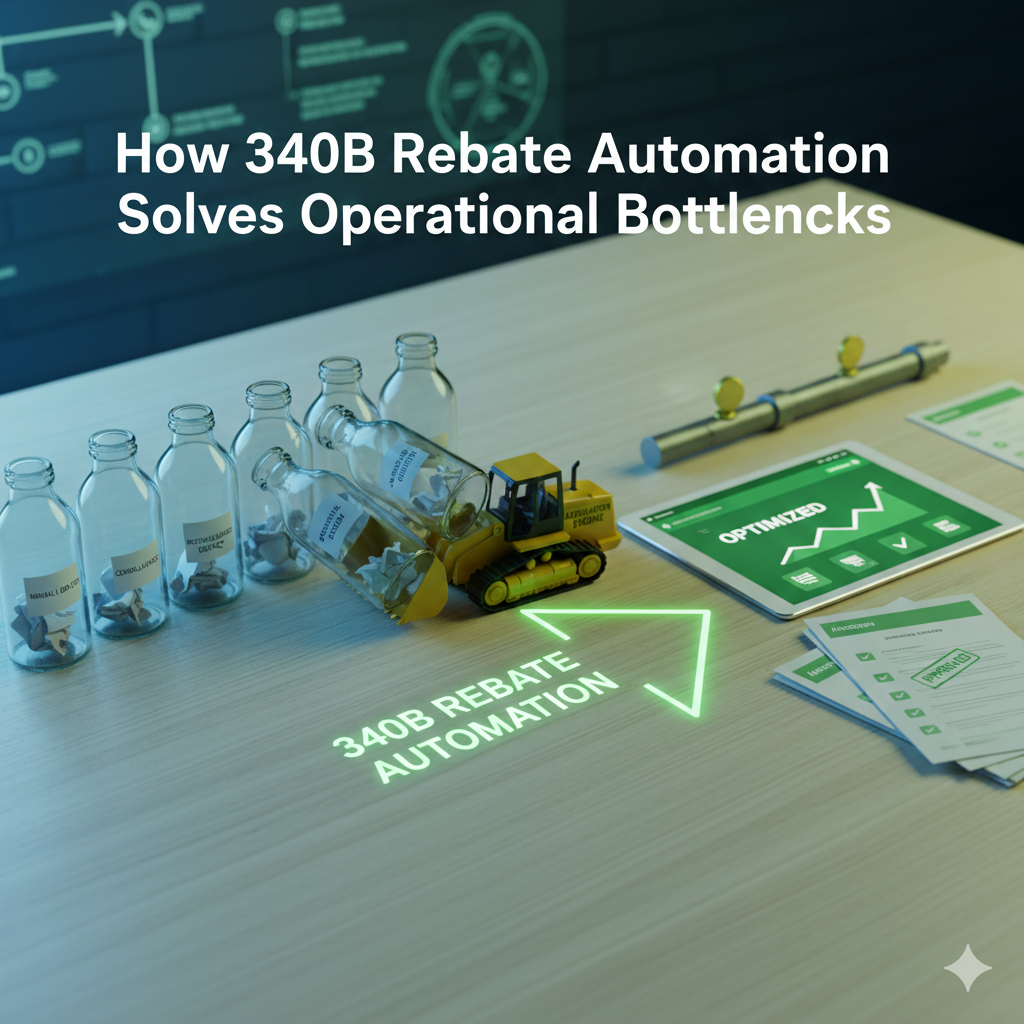

The 340B program is undergoing a massive shift: we are moving from an “up-front discount” world to a “rebate flow” world.
Historically, the benefit happened right at the counter. However, in the rebate model, Covered Entities (CEs) may purchase at full price and only receive their money back later, after undergoing a gauntlet of eligibility checks and validations on new platforms.
For TPAs, this changes your job description entirely.
- The Old Job: Get claims in, apply some rules, generate a file.
- The New Job: Create a defensible submission, prove it’s valid, handle rejections, and be able to reconstruct the full story when an auditor knocks on the door.
This is a blueprint for building that capability without turning your tech stack into a fragile web of scripts and stress.
The TPA’s New Reality: You Are the Translator
Whether you asked for it or not, you are now the critical translation layer between:
- Covered Entities (who need their money).
- Pharmacies & Switches (who generate the data).
- Beacon & 340B ESP (the new gatekeepers).
Beacon handles the rebate submissions. 340B ESP handles the data sharing and duplicate discount checks.
And You sit in the middle. Your architecture must ensure data flows correctly between all of them.
What Your Clients (The CEs) Will Expect
In this new era, telling a CE “we submitted the file” isn’t enough. They need confidence. They will expect:
- Straight Answers: Are you Beacon-ready? (Not a vague “it’s on the roadmap”).
- Precision: Reliable consolidation of pharmacy and medical claims.
- Transparency: If a claim is rejected, they need to know why fast.
- Auditability: Every dollar needs a paper trail.
The “Spaghetti Stack” Trap
Let’s be honest about what many TPA tech stacks look like today. It’s often a mix of:
- Feeds are arriving from everywhere in different formats.
- CSV dumps and SFTP folders stitched together by one developer who left two years ago.
- Business rules hidden inside SQL queries and custom reports.
If you try to bolt Beacon and ESP onto this “spaghetti architecture,” you are setting yourself up for failure. You get a fragile system right when your customers need stability.
The Solution: The 5-Stage “Beacon-Ready” Engine
You don’t need magic; you need a clean pipeline. The simplest, most effective model has five stages:
Ingest -> Normalize -> Rules ->Submit->Track
Here is how to build it so it doesn’t break.
1. Ingest & Normalize (Make Data Trustworthy)
The Problem: Data comes in messy.
The Fix: Don’t just accept files; tag them. When a claim is rejected six months from now, you need to know exactly where it came from (Source, Date, Version).
The Secret: Normalization. Stop treating every feed as a special case. Map everything to one “Canonical Claim Schema” (a standard internal language). This allows you to add new partners without rewriting your entire codebase.
2. The Rules Layer (The Brain)
The Problem: Hardcoding rules into scripts.
The Fix: A centralized rules engine. This is where you decide eligibility for Beacon submission, ESP checks, and Medicaid carve-outs.
The Secret: Keep the “Manufacturer Rules” separate from your core code. Manufacturers change their logic constantly (Lookbacks, LDA logic, Exclusions). If you have to deploy new code every time a manufacturer tweaks a rule, you will drown. Make the rules configurable, not hard-coded.
3. Submissions & Tracking (The Output)
The Problem: Treating submissions as “Fire and Forget.”
The Fix: Use Adapters. Beacon and ESP will change their file formats. By using adapters, you can update the connection without breaking your core engine.
The Secret: Lifecycle Tracking. You need to move beyond “Success/Fail.” You need to track a claim from ingestion to submission to rejection to reconciliation. If you can’t reconstruct the story of a single claim instantly, you don’t have an engineyou just have a file generator.
Patterns to Watch For
There are clear right and wrong ways to build this.
- The Anti-Pattern: Scattering rules across SQL and one-off scripts.
- The Good Pattern: A centralized, versioned rules engine.
- The Anti-Pattern: Hard-coding logic for specific platforms like Beacon.
- The Good Pattern: Using “Adapters” to talk to external platforms, keeping your core clean.
- The Anti-Pattern: “Fire-and-forget” file drops.
- The Good Pattern: Full lifecycle logging and tracking.
The Bottom Line: If you follow the anti-patterns, you panic during audits. If you follow the good patterns, you can confidently say, “Here is exactly what happened.”
A Concrete Path: Where RxFiler Fits
If you are looking at this blueprint and thinking, “We need this, but building it from scratch will take a year,” that is where RxFiler comes in.
RxFiler is a backend, rules-driven claims engine built specifically for this transition. We built the infrastructure so you don’t have to. It handles the Ingest, Normalization, Rules, and Submission adapters out of the box.
Important: RxFiler is infrastructure, not a competitor. You keep your CE relationships and your operating model. We just power the engine room to make sure your submissions are compliant and your data is visible.
Next Steps
If your team is preparing for Beacon and ESP, the fastest way forward is a gap analysis. Compare your current flow to the 5-Stage Model above. Where are the cracks?
-> If you want to see how RxFiler handles this pipelineand how we can plug into your current stack to get you Beacon-Ready in months, not years let’s schedule a demo.
Ready to bring clarity to your 340B program?
Whether you’re preparing for ESP/Beacon requirements, validating data quality, or reducing compliance risk, we help you move forward with confidence—without forcing you into a new platform.